
Today in AI3 min read
OpenAI, Anthropic and Google Are Teaming Up on AI Safety
The companies building some of the world’s most powerful artificial intelligence systems are increasingly finding common ground on one important issue: AI safety can’t be an afterthought.
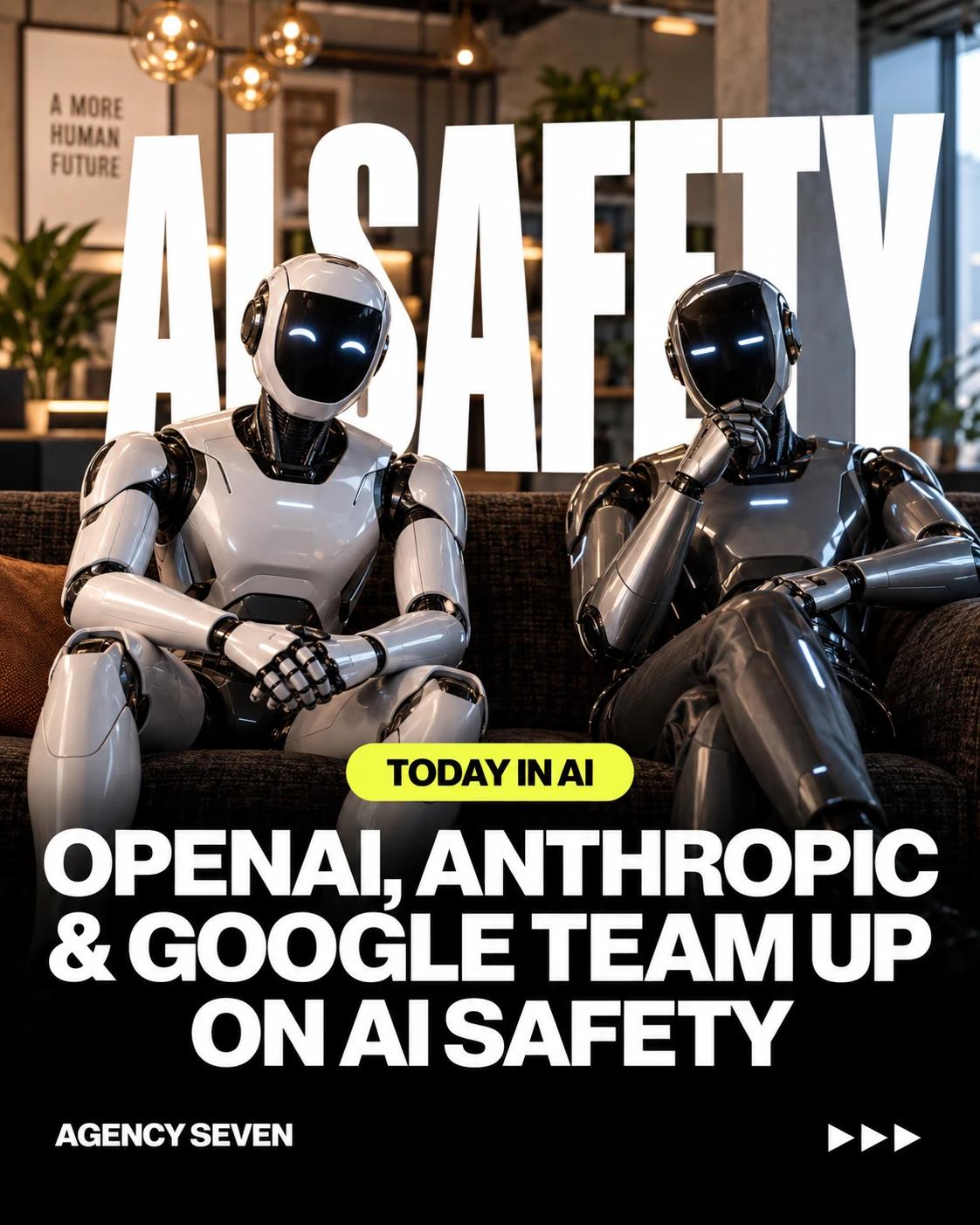
OpenAI, Anthropic and Google have all been pushing the frontier of AI capabilities forward, but the conversation around advanced models is changing. Alongside competition, there is now growing emphasis on shared safety practices, evaluations, security, and responsible deployment.
That matters because the next generation of AI systems will not just answer questions.
They will increasingly take actions, use tools, write code, operate software, and interact with real-world systems.
Why AI safety is becoming a shared priority
As AI systems become more capable, the potential upside grows dramatically.
So do the risks.
That is why frontier AI companies are spending more time on things like:
- independent model evaluations
- alignment testing
- cybersecurity safeguards
- monitoring agent behavior
- deployment controls
- human oversight
- shared industry standards
The goal is not to stop innovation.
It is to make sure safety improves alongside capability.
The biggest AI companies still compete

OpenAI, Anthropic and Google are still fierce competitors.
They are competing on model quality, coding ability, multimodal systems, agents, enterprise adoption, developer tools, and infrastructure.
But some issues are bigger than product competition.
When increasingly powerful AI systems can affect cybersecurity, scientific research, software development, business operations, and eventually physical systems, safety becomes an industry-wide problem.
A mistake from one major AI system can affect trust in the entire category.
That gives companies a strong incentive to collaborate on common standards even while competing commercially.


AI agents make safety more important
The move toward AI agents is one of the biggest reasons this discussion matters.
A chatbot mostly generates information.
An agent can potentially:
read → decide → act → verify → continue
That could mean updating a CRM, deploying code, researching competitors, sending emails, analyzing documents, or interacting with other software.
The more authority an AI system receives, the more important its permissions and safeguards become.
Businesses adopting AI agents will need to think carefully about questions such as:
- What information can the agent access?
- What actions can it perform without approval?
- How is its activity logged?
- What happens when it makes a mistake?
Those questions will become a normal part of implementing AI inside companies.
This is actually good news for businesses

Stronger AI safety standards could ultimately make AI easier for businesses to adopt.
Most companies do not want experimental systems running critical workflows without safeguards.
They want AI that is: reliable, predictable, secure, measurable, and useful.
The more confident businesses become in those characteristics, the more comfortable they will be automating real processes.
That is where AI moves from an interesting technology into everyday infrastructure.
Cooperation could accelerate adoption
At first glance, more testing and regulation can sound like something that slows innovation down.
But trustworthy systems can actually accelerate adoption.
Businesses are much more likely to deploy AI when they understand how it has been evaluated.
Developers are more likely to give agents access to important systems when strong monitoring exists.
Customers are more likely to interact with AI when organizations are transparent about how it works.
So collaboration on safety does not necessarily mean less innovation.
It could be what allows AI to become much more widely used.
The next AI race is about more than intelligence

The AI industry will continue competing to build smarter models.
But another race is happening at the same time:
Who can build AI that people trust enough to actually use?
The winners may not simply have the highest benchmark scores.
They may be the companies that successfully combine powerful AI with reliability, security, transparency, and useful real-world applications.
That is likely to become increasingly important as AI moves deeper into everyday business operations.
Learn this with us
AI Tech Training
The hands-on track — agents, prompts and the workflows that run them.
Start AI Tech TrainingAI Business Training
The operator track — where AI saves hours and wins more customers.
Start AI Business Training