
Today in AI3 min read
Why “Codex Pro Plans Are on Hold” Became the Perfect AI Meme
The AI industry has spent the last few years racing to build faster models, smarter agents, more capable coding tools, and increasingly autonomous systems.
Now, some of the biggest names in artificial intelligence are talking much more openly about something different:
Slowing down long enough to make sure the technology is safe.
That shift inspired a simple joke:
Maybe this is why the Codex Pro plans are “on hold.”
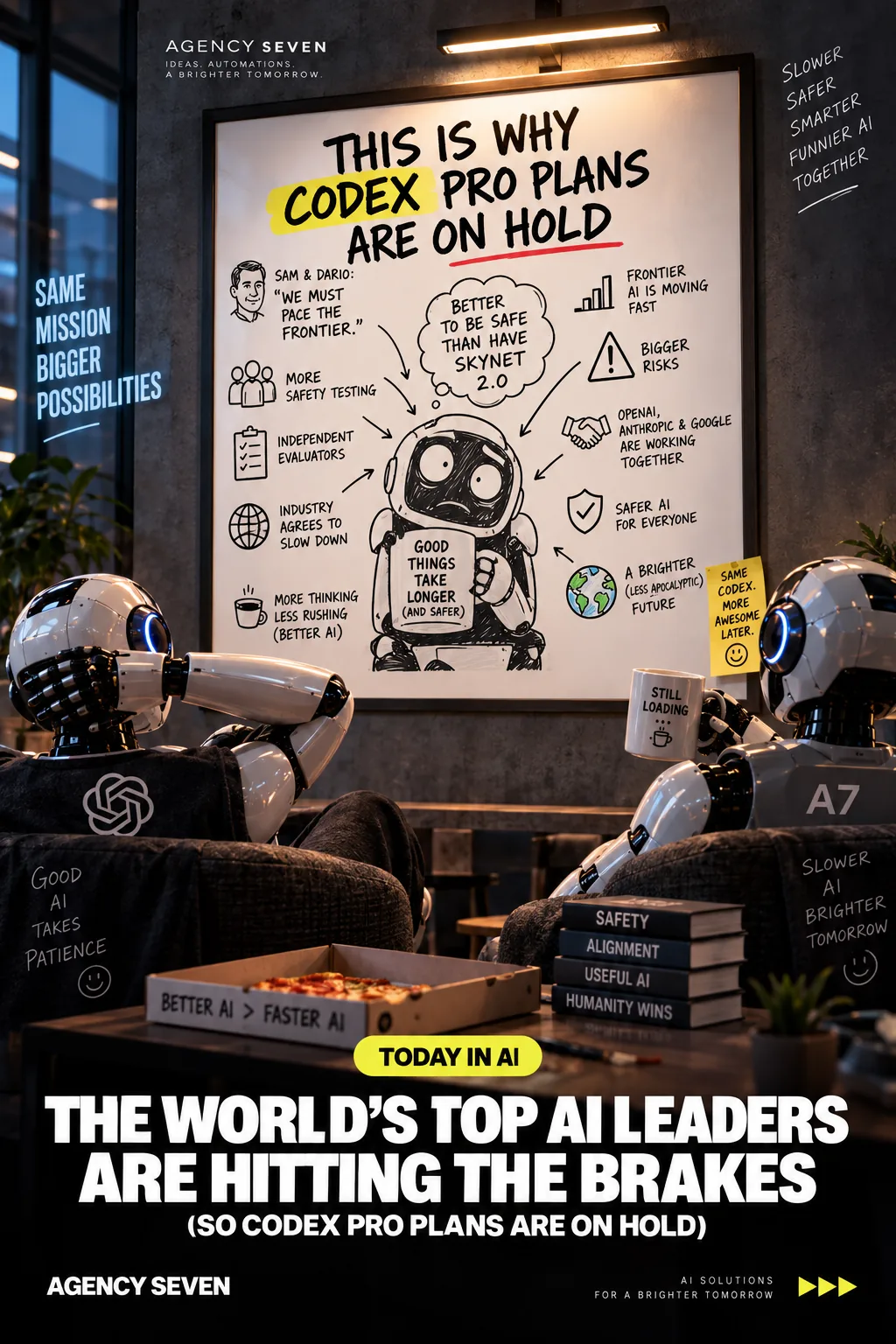
To be clear, the poster is satire — it is not claiming that OpenAI officially paused a Codex Pro plan because of AI-safety concerns.
But the joke works because it reflects a very real conversation happening across the AI industry.
AI leaders are talking about pacing the frontier
As frontier AI systems become increasingly powerful, researchers and executives are debating how quickly the industry should continue pushing ahead.
The discussion is moving beyond theoretical AI safety.
Companies are now thinking seriously about independent evaluations, model oversight, alignment testing, security controls, and what kinds of safeguards should exist before increasingly autonomous AI systems are deployed.
In other words, the industry is starting to ask a question that would have sounded unusual during the early generative-AI boom:
Should we build everything as fast as technically possible?
The answer from some leading AI researchers appears to be: not necessarily.
Coding agents make the question more urgent

AI coding tools are a perfect example of how quickly capabilities are expanding.
Tools such as Codex can already assist with tasks including writing code, debugging applications, understanding repositories, generating tests, refactoring software, and helping developers move from an idea to a working product much faster.
As these systems become more autonomous, the line between an AI assistant and an AI software engineer starts becoming less obvious.
That creates enormous opportunities.
It also creates new questions.
How much access should an AI coding agent have?
What should it be allowed to deploy automatically?
How should companies evaluate its behavior before giving it access to production systems?
And what happens when agents can operate for hours without direct human supervision?
Those are no longer hypothetical questions for software companies.
“Better AI > Faster AI”
The funny part of the poster is that the robots themselves seem exhausted by the AI arms race.
Pizza on the table.
A coffee mug reading “Still Loading.”
A robot staring at a safety diagram.
And a whiteboard that essentially says:
Maybe we should make sure this thing works safely before turning it into Skynet 2.0.

Underneath the humor is a fairly sensible principle:
Better AI is more valuable than simply faster AI.
For businesses, reliability matters much more than benchmark headlines.
A slightly less capable AI system that consistently performs a task correctly can be far more useful than an extremely powerful system that behaves unpredictably.
This could actually be good news for businesses

Companies adopting AI do not need to participate in the frontier-model race.
Most businesses have much simpler problems to solve.
They need better websites.
Faster customer support.
Automated lead qualification.
Internal knowledge search.
Document processing.
Better workflows.
AI-assisted sales.
Custom software that removes repetitive work.
The most valuable AI implementation is often not the most futuristic one.
It is the one that saves employees five hours every week or turns more website visitors into customers.
That is where the real opportunity currently exists.
The AI race may be entering a more mature phase
The first phase of generative AI was largely about proving what was possible.
The next phase may be about figuring out what is actually useful — and how to deploy it responsibly.
AI companies will continue shipping new models, coding agents, APIs, and automation tools.
That is unlikely to stop.
But the conversation surrounding those releases is changing.
Safety, evaluations, reliability, governance, and human oversight are increasingly becoming part of the product discussion rather than something considered afterward.
And if that means occasionally letting the robots sit down, order a pizza, and think things through before shipping the next AI agent…
That might not be such a bad idea.
Learn this with us
AI Tech Training
The hands-on track — agents, prompts and the workflows that run them.
Start AI Tech TrainingAI Business Training
The operator track — where AI saves hours and wins more customers.
Start AI Business Training